May 29, 2026
From Commands to Intent: Three Key Shifts in Smart Hardware Interaction
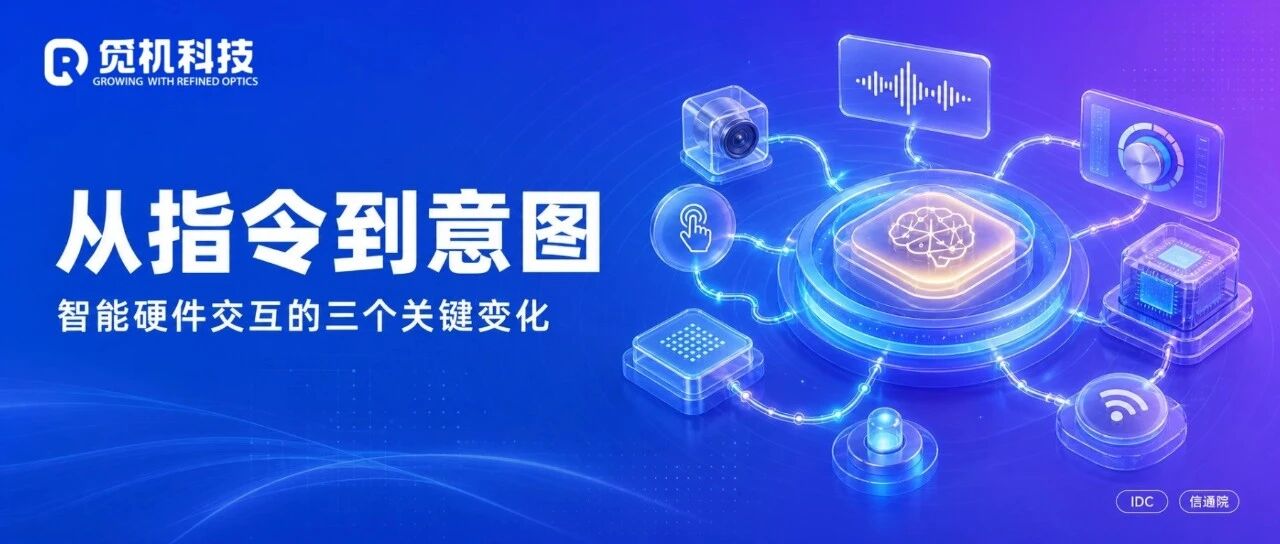
In its recent *Blue Book on Next-Generation Smart Devices (2025)*, the China Academy of Information and Communications Technology (CAICT) noted that next-generation smart devices are exhibiting characteristics such as “cognitive collaboration, scenario anticipation, intent-driven operation, and service symbiosis.”
IDC’s observations on China’s smart device market in 2026 also indicate that multimodal perception, semantic understanding, and local intelligent processing are driving device interactions from explicit input toward natural understanding.
These observations point to a single shift: the value of smart hardware is no longer determined by the sheer number of features, but rather by competition in interaction comprehension, response stability, and scenario adaptability.
The first sign:
Devices no longer rely solely on a single control interface
Voice, touch, sensors, vision, status data, location changes, and device interconnectivity can all serve as clues for the system to understand user needs.
What truly impacts the user experience is not merely whether a single input method is user-friendly, but whether these inputs can be integrated to form a comprehensive understanding of the context.
Take lighting as an example: what users often need is not an isolated brightness value, but a comfortable lighting environment tailored to different scenarios such as reading, dining, watching movies, or getting up at night.
If a device can only wait for explicit commands (“Set brightness to 60%”), interaction remains limited to “command execution”; but if it can combine time, ambient light, and user status to automatically generate the appropriate lighting profile, interaction truly becomes natural.
The second signal:
Computational Capabilities Are Shifting to the Device Itself
The importance of on-device processing is rising, not because the cloud is unimportant, but because smart hardware itself demands higher standards for response speed, privacy protection, offline functionality, and stable control.
Users will not tolerate slow responses, offline inoperability, or frequent false triggers simply because the system is “smart.”
Therefore, when it comes to intent understanding, we must look beyond the strength of cloud-based models and also consider whether the device can handle local wake-up, offline commands, error handling, and status feedback.
For home devices, reliability is often more important than cutting-edge features. A single operation with no response or a single instance of a light turning on by mistake can directly undermine user trust in the product.
The third signal:
Proactive services must establish reasonable boundaries
Intent understanding does not mean the device can make all decisions for the user.
The more proactive a system is, the more it needs to be explainable, controllable, and capable of being turned off. In complex environments, predictions may be inaccurate; in low-frequency scenarios, data may be insufficient; and excessive proactivity can become a nuisance.
Effective smart interaction requires striking a balance between “reducing user effort” and “preserving user control.” Key actions should provide clear feedback (such as gradual rather than sudden changes in lighting), sensitive operations should require authorization, proactive services must be understandable to users, and local capabilities should maintain basic functionality even during network outages.
The fact that smart hardware has entered the “intent understanding” phase does not mean devices need to become more complex. On the contrary, truly mature smart interactions should make things feel simpler for users:
One fewer step
One fewer accidental trigger
One less wait
More stability and certainty
The shift from “commands” to “intent” transforms not only the technical approach but also the relationship between people and light, and between people and their daily lives—devices are beginning to learn and understand people’s true needs, rather than forcing people to adapt to the devices’ rules. This is the direction in which smart hardware is heading.