August 7, 2025
From the showroom to the scene: forging machine technology AI lighting to accelerate the landing of the party service position
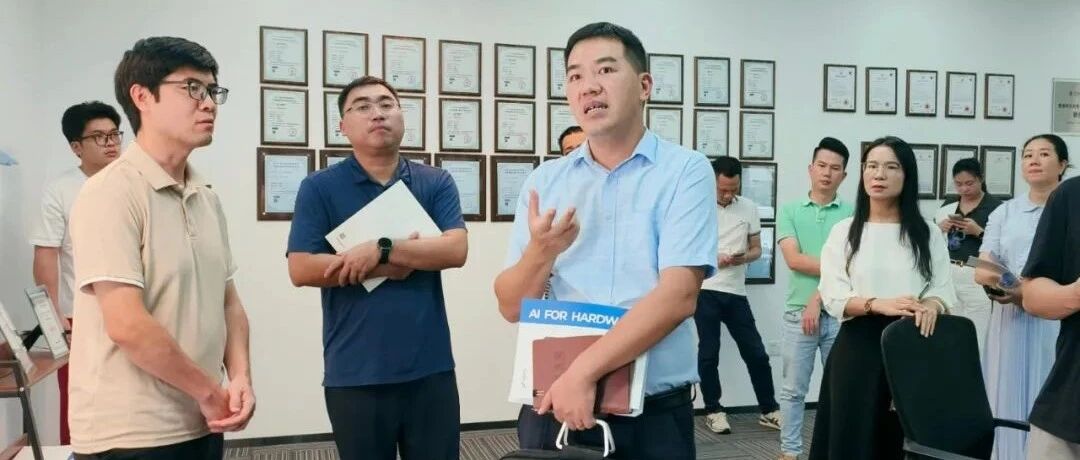
On August 6, Kang Yongbin, Director of the Organization Department of the Bao’an District Committee of the Communist Party of China in Shenzhen, and Chen Qun, Section Chief of the Party Building Center at the District Committee’s Organization Department, led a delegation of 20 people—including officials responsible for Party and mass services from various subdistricts and communities—to conduct an on-site investigation into the technical solutions and application outcomes of MiJi Technology’s AI lighting products. The investigation featured in-depth exchanges and discussions centered on the theme of “How AI Lighting Can Precisely Empower Grassroots Services.”
Inside the exhibition hall, technical leaders systematically presented the core logic and capabilities of AI lighting technology through a combination of “scenario-based demonstrations and hands-on explanations.” Addressing common lighting pain points in community settings, they used simulated spatial displays, parameter analysis, and functional demonstrations to intuitively showcase the adaptability and human-centered value of AI lighting in public service scenarios.
The event highlighted three key solutions tailored for grassroots scenarios:
Health Lighting Scenario: The AI circadian lighting system dynamically adjusts blue light ratios and illuminance levels based on human circadian rhythm models, precisely matching activity scenarios such as reading and office work to create a healthier and more comfortable lighting environment;
Smart Service Scenarios: The AI Reading Companion solution integrates functions such as voice narration, content interpretation, eye-protective lighting distribution, and policy promotion. Through a "hardware-software integrated" design, it enables lighting equipment to deliver public content and information services;
Accessible Interaction Scenarios: Supporting multi-modal interaction methods such as voice control, mobile apps, mini-programs, touch panels, and physical knobs, the system offers simple operation and is particularly suitable for the elderly and people with limited mobility, fully embodying a “people-centric” product philosophy.
After experiencing the exhibition hall, the delegation highly praised the tangible and practical implementation of AI lighting. Director Kang Yongbin noted that MiJi Technology’s products precisely address pain points in grassroots services, demonstrating significant perceptibility and practicality. He expressed hope that through government-enterprise collaboration, technological innovation would be transformed into broader and deeper improvements in public service efficiency.
On-the-Spot Discussions: Enthusiastic Feedback from Grassroots Units and Preliminary Cooperation Agreements
Multiple cooperation intentions were established on the very day of the visit. Following the event, several street and community leaders proactively provided feedback on specific application needs, including:
Age-friendly lighting retrofits for senior activity centers;
Upgrading eye-protective lighting systems in community libraries;
Construction of multifunctional lighting environments for Party-mass service centers.
Some grassroots units have already extended invitations, hoping that the Miji Technology team will conduct on-site surveys as soon as possible. By taking into account the actual spatial layout and the characteristics of the target population, they aim to develop tailored implementation plans to ensure that what was “seen on-site” is quickly transformed into “practical services.”
Continuing to Deepen Engagement at the Grassroots Level: Making Technology “Down-to-Earth” and Lighting “Warmer”
MiJi Technology will consistently uphold a “user-centric, scenario-driven” product strategy, continuously iterating the capabilities of its AI lighting products for Party and community service scenarios in the new era, and driving the evolution from standalone lighting to the integration of “light + service.” In the future, the company will further increase its investment in technology, deepen collaborative mechanisms with sub-district offices and communities, and work together to create more replicable and scalable AI lighting application benchmarks, ensuring that every beam of light is warmer and more attuned to human needs.